Hiding power caused by the special structure of fillers
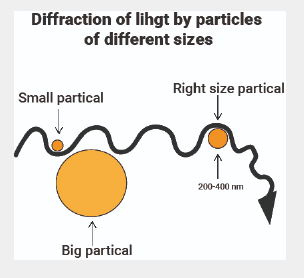
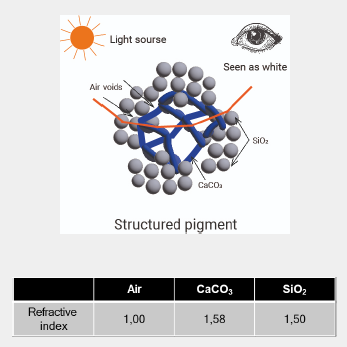
This second type of hiding power is formed due to numerous voids within the material, such as air bubbles or micro-pores, which have a different refraction index than the surrounding medium (varnish, polymer, paint). The mechanism can be described in more detail as follows:
Initially, voids are formed (for example, air pockets, microcapsules, or spherical hollow particles).
At the “paint-air” interface, partial reflection and scattering of light occur.
Multiple scattering either absorbs or reflects light back,
reducing the transparency of the layer. As a result of this effect, the material appears white or light rather than transparent.
Examples of such pigments include flash calcined kaolins, hollow microspheres, silicas.
These fillers are used in paints with high PVC (volume concentration of pigment).
Therefore, using fillers or pigments with numerous voids or a pronounced textured surface is a promising method for partial or complete replacement of titanium dioxide in certain types of white and colored paints.
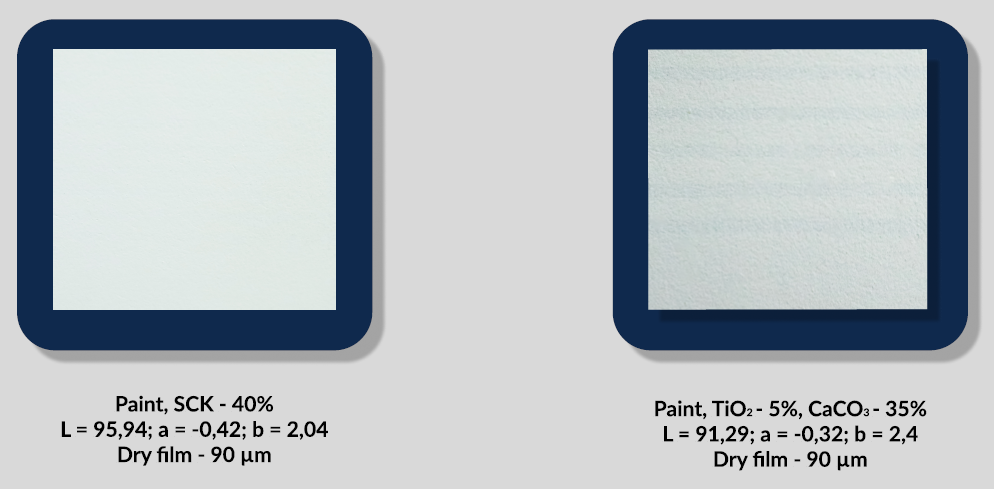
Particles of white pigment/filler CSK have got both closed voids and well structured surface. These features ensure high levels of light scattering and absorption. CSK filler is intended for use in the production of white matte paints with low or zero TiO₂ content.
Properties of the CSK filler:
Developed surface providing effective light scattering and absorption.
Closed cellular internal structure.
High whiteness level, L = 96–97%.
Low yellowness, b ≤ 2.
Ability to be incorporated up to 40% into paint formulations.
Potential to replace TiO₂ from 30% to 100%.
Modifies the paint film structure (modify the packing structure).
Suitable for use in the production of interior and exterior paints, colored paints, especially yellow and red variants.
Competitive price.
Chemical Composition:
CaCO₃ – 44,50%
SiO₂ – 32,85%
Al₂O₃ – 22,50%
Water soluble matters – 0,15 %
Moisture – ≤ 0.5%
Physico-chemical Properties:
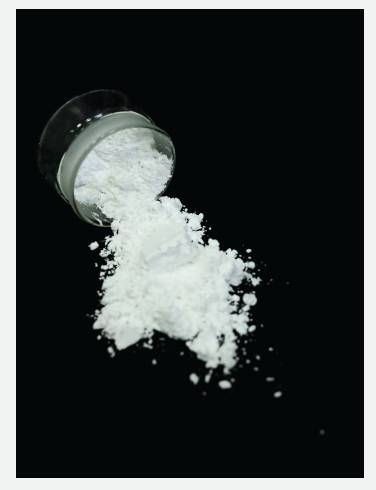
Appearance: White, fine-disperse powder
Bulk density: 0.5 g/cm³
Particle size: 5–20 micrometers
Whiteness: ≥ 96%
Solubility: Insoluble in water
pH (10% aqueous suspension): 6.0–7.5
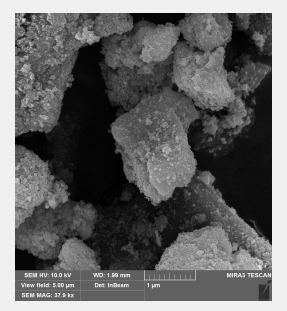
The surface image of CSK obtained using SEM. The indicated dimensions indirectly provide an idea of the characteristic sizes of the protrusions and depressions.
The following paint formulation was used for testing the coloring capacity and hiding power of the pigments:
Acrylic dispersion: 30%
Water: 69%
Dispersant Flosperse 3000: 0.5%
Cellulose thickener Cellosize 4400: 0.5%
Comparison of coloring capacity and hiding power of different pigments: